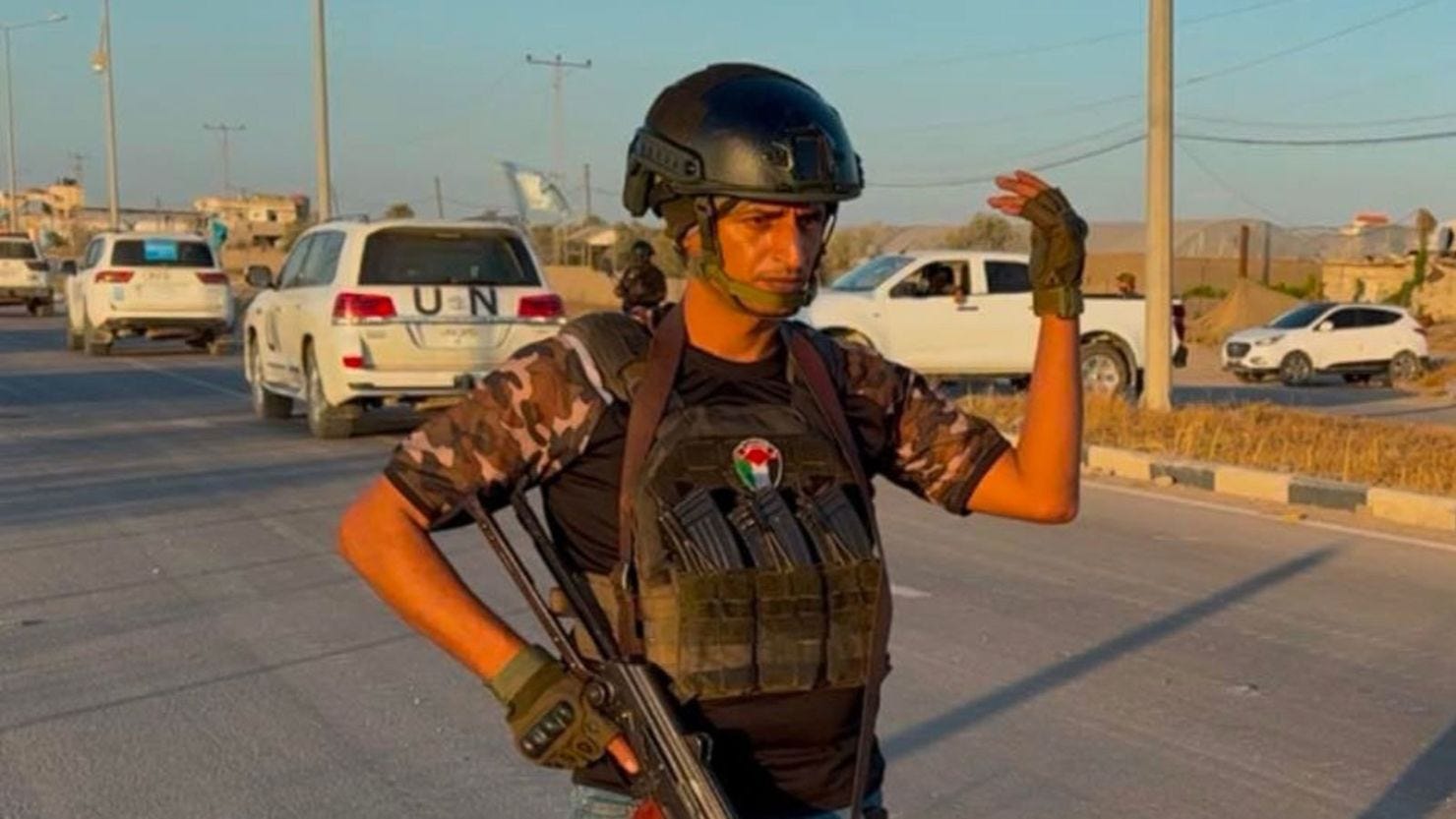
Whatever Happened to Yasser Abu Shabab?
Yasser Abu Shabab, once touted as a pro-Israel ally, was killed over a week ago. His relatively un-mourned death showed the real intent of the IDF's support: using Rafah to ethnically cleanse Gaza.
In June, the Center for Peace Communications, a pro-Israel NGO, carried an “exclusive” message, a first public statement, from the leader of an anti-Hamas militia inside Gaza. Yasser Abu Shabab, the leader of the so-called Popular Forces based out of eastern Rafah, claimed his organization was fighting to protect the Palestinian people from “Hamas terrorism”, to one day “expand into other areas controlled by Hamas through armed force”, and that its suspicious presence in an entirely ethnically-cleansed neighborhood under the complete control of the Israel Defense Forces was of no matter: it was only so that Palestinians escaping Hamas’ rule could be protected.
By October, affiliates of the Popular Forces had emerged in places in nearby Khan Younis, and as far north as Beit Lahia. Other allied organizations with similar names, such as the Popular Defense Forces, have also emerged in neighborhoods of Gaza City such as Shuja’iyya. All have emerged within ethnically-cleansed areas of the Strip, operating directly under the IDF’s purview and coordination. Abu Shabab boasted to The Washington Post that 2,000 Palestinians had come to their areas under their control in Rafah alone, and images from its Facebook page touted “special operations” to bring opponents of Hamas to its safe shores, abundant supplies of food, and barebones (but still available) medical care in a territory which has seen its healthcare system destroyed by Israeli fire.
By December, Abu Shabab was dead. Despite his stated intent to one day meet Hamas in great, liberatory battle, various narratives surrounding the circumstances of his death all carry with them various degrees of humiliating banality. The Popular Forces stated that Abu Shabab was shot dead while mediating a dispute within the Abu Sanima family, another prominent clan in Rafah. Ynet, an Israeli news site, claimed Abu Shabab was not shot, but beaten to death over an argument over the level of the group’s collaboration with Israel. Hussam al-Atsal, a commander in a former Popular Forces affiliate in Khan Younis, said he was killed in a simple dispute over money.
It was a striking contrast between the image of the organization that had been touted by Netanyahu only the day before, who when interviewed at the New York Times Dealbook Summit remarked:
“Right now, there are Palestinians in Gaza who are fighting Hamas because they say, ‘Enough of this tyranny, of terror.’ And these people, they don’t want the PA, the Palestinian Authority. They don’t want Hamas. They want to be masters of their own destiny. And I think we should give them a chance.”
Abu Shabab, despite being killed mere hours later, was not publicly mourned by Netanyahu in any forum, despite his praise of his group’s efforts and his conviction about the importance of the Popular Forces in the post-war governance of Gaza. In fact, not many inside or outside Gaza seem to have mourned his death either in the week that has passed. While fighters in the group prayed over his body within IDF-controlled Rafah, Palestinians in Hamas-controlled parts of Khan Younis handed out sweets to celebrate his death, and Palestinian refugees in southern Lebanon, decidedly outside Hamas’ administration, did the same. Condolences seemed to stream in from only one sector in particular: the American mainstream media.

While other outlets had spoken before about the Popular Forces’ involvement in looting aid trucks and enforcing the famine on Gaza, the Wall Street Journal’s treatment of Abu Shabab’s gang has been nothing if not effusive. After his death, the Editorial Board issued what amounted to a collective obituary, saddened that Hamas had effectively purged “anyone who would end the Palestinian forever war against Israel” and lamented that “Any Palestinian who tries to change that usually ends up dead.” Abu Shabab had in fact contributed an op-ed to the WSJ in July, ostensibly written by him despite even friendly Israeli media outlets reporting that he was illiterate. In the pages of the Journal, Abu Shabab sang the praises of his organization’s achievements, bragging that for those in eastern Rafah, “the war is already over”, portrayed himself as having took up arms on his own rather than through Israeli support, and said that he was willing to handle the civil affairs of 600,000 Palestinians displaced from Rafah who could return to be governed by an “independent Palestinian administration” under his leadership.
The Free Press, the conservative media outlet founded by Bari Weiss (now editor-in-chief at CBS News), also spared little effort in extolling Abu Shabab’s virtues. The Center for Peace Communications, whose shadowy origins and connections in the Israel lobby space have been reported on by Drop Site News, has also funneled content about Abu Shabab through The Free Press. The result has been whitewashed coverage, allowing him to deny, without follow-up questions, his well-reported connections with ISIS, that his organization has systematically stolen humanitarian aid, or that he was even arrested for drug smuggling years prior. Other published reporting from The Free Press claims that the Gaza peace plan advanced by Trump, one in which he personally oversees a foreign board that controls Gaza’s new, post-Hamas government, has popular backing, showcasing Abu Shabab’s allies praising the plan, sitting amongst other leaders and fighters clearly capable of taking control on the ground from Hamas.
Western media outlets seizing on stories of seemingly democratic, freedom-loving opponents of the governments of American adversaries is not new. Before the invasion of Iraq, many American newspapers were awash in stories about the ways Ahmed Chalabi (later convicted of bank fraud in Jordan), was preparing for a post-Saddam society. As war builds on the shores of Venezuela, many American outlets are similarly awash in stories about the bravery of Maria Machado, attempting to place some liberal distance between her image and her obsessive support of Donald Trump’s strikes on accused drug boats in the Caribbean.
The intent of these and many more examples is to portray such figures as much more palatable and aligned with the median American reader’s values than they may actually be in reality, but with Abu Shabab, the intent is much more far-reaching. The intent is to obfuscate the actual plan of Israel with the militias, and with what they are planning to do with Rafah. It is not to make it a long-term, peaceable state that will give the Palestinians a new future, it is to make it the final staging ground for the ethnic cleansing of the Gaza Strip.
In July, Israeli Defense Minister Israel Katz told journalists that the country was planning to establish what he called a “humanitarian city” in Rafah, which the army had already largely razed since taking it in April. He envisioned 600,000 already displaced people being moved into the area, and eventually the entire population of the Gaza Strip, with the eventual goal of encouraging “voluntary migration” from the territory, a commonly-used euphemism for expulsion that is very much forced. Yasser Abu Shabab’s op-ed, citing the same 600,000 figure but claiming the Palestinians would be able to forge a new future there, appeared only 2 weeks later.
While Netanyahu would made claims to the American media that anti-Hamas militias in Gaza could represent a new era for the Palestinian people, he made no such claims to Israeli audiences. In June, when Israeli journalists began questioning Yasser Abu Shabab’s connections to both Israel and ISIS-linked criminal gangs, Netanyahu outlined its relationship with his militia in purely transactional, cold terms: “We activated clans in Gaza that oppose Hamas. What’s wrong with that? It’s only good. It only saves the lives of IDF soldiers.”
As the ceasefire in Gaza has plodded on, with Palestinians still being killed, medicine shortages still abundant, and reconstruction still being blocked, reconstruction is reportedly being fast-tracked in ethnically-cleansed areas of the Strip, behind the new Yellow Line which is rapidly becoming the Strip’s new border. The new buzzword being used by the White House are “Alternative Safe Communities”, freshly constructed compounds which would give Palestinians, cleared by Israeli intelligence, opportunity by giving them paying jobs and a place to live (places that the same militaries had either directly or assisted in destroying). Israeli officials, according to The New York Times, want to impose restrictions so that Gazans who move into these new compounds can never leave them. The contractor for the infamous migrant detainment camp in Florida, Alligator Alcatraz, known as Gothams LLC, is apparently one of the top contenders to assist in such reconstruction efforts.
Even if Israeli officials had not directly or indirectly communicated their desire for Rafah to be the staging ground for ethnic cleansing, Netanyahu’s terms for the return of the Palestinian Authority to Gaza, something outlined in the Gaza peace plan, are near-impossible, if not outrightly so. In addition to typical demands, like holding regular elections (which the Palestinian Authority has not done since 2006), Netanyahu has also demanded the “de-radicalization” of Palestinian society, particular in its educational system.
While Netanyahu claims such things occurred in Germany and Japan, the actual conditions of a “de-radicalized” Palestinians society palatable to Israel can be found in IDF-controlled areas in the West Bank, where returning residents to the Jenin refugee camp have been forbidden from any political activity, and Israel’s intelligence services reserve the right to refuse anybody their own right to return and live in their own homes, on their own streets. Israel is also reportedly forcing the Palestinian Authority to permanently resettle half of the displaced outside the camps in which they previously lived.
In IDF-occupied Rafah, a sliver of the kind of education system Netanyahu envisions as the ideal for Palestine can be seen: children reciting obvious maxims about being friends with Jewish people and Christian people for Western cameras, while the bombed-out ruins of their classroom, the conditions of the world around them, are left entirely unaddressed, the occupation a crushing phantom.
As plans for forcible displacement in Gaza march on, outlets who backed Abu Shabab have taken little time to mourn or, ideally, reconsider who they have been pushing. The Wall Street Journal, only a few days later, published a new op-ed by the next most popular IDF-backed militia leader: Hussam al-Astal, leader of the palatably-named “Counter-Terrorism Strike Force”. Al-Astal has readily asserted that he is ready to report directly to the Board of Peace, that he has already “arrested” Hamas fighters in his operations, and called on America to begin investing “heavily” in parts of Gaza under IDF control.
“Mr. Trump’s 20-point plan offers Gaza a real future,” he finishes by saying, “We stand ready to make it a reality.”