"The Rapid Killing Stopped, and the Slow Killing Began": A Conversation with Wasim Said
Palestinian author Wasim Said speaks from the Gaza Strip about current winter conditions, writing a book during a genocide, and how he sees narratives of reconstruction and resilience.
Last week, Winter Storm Byron swept through the Mediterranean. While Israel battled power outages and trapped cars in the floods, in the Gaza Strip, where the Israeli military has destroyed or damaged more than 80% of buildings and left the vast majority of the population displaced and homeless, the effects of the storm have been vastly more dire. More than 27,000 tents flooded, a two-week old child died from hypothermia, and Palestinian Civil Defense recorded 5,000 distress calls around the Strip. 12 died not from drowning or from the cold, but from the wind battering damaged buildings and walls, which then fell, of which there are 13 recorded collapses.
The devastating effects of the storm have been amplified by the blocking of reconstruction materials into areas of the Strip controlled by the local Palestinian government, led by Hamas. Despite provisions in the ceasefire deal in October outlining the entry of temporary homes for the displaced, no such homes have entered in the preceding months, with reconstruction instead to be prioritized for areas behind the Yellow Line, where Palestinians have been ethnically cleansed from, and only IDF-organized militias and their collaborators operate and reside.
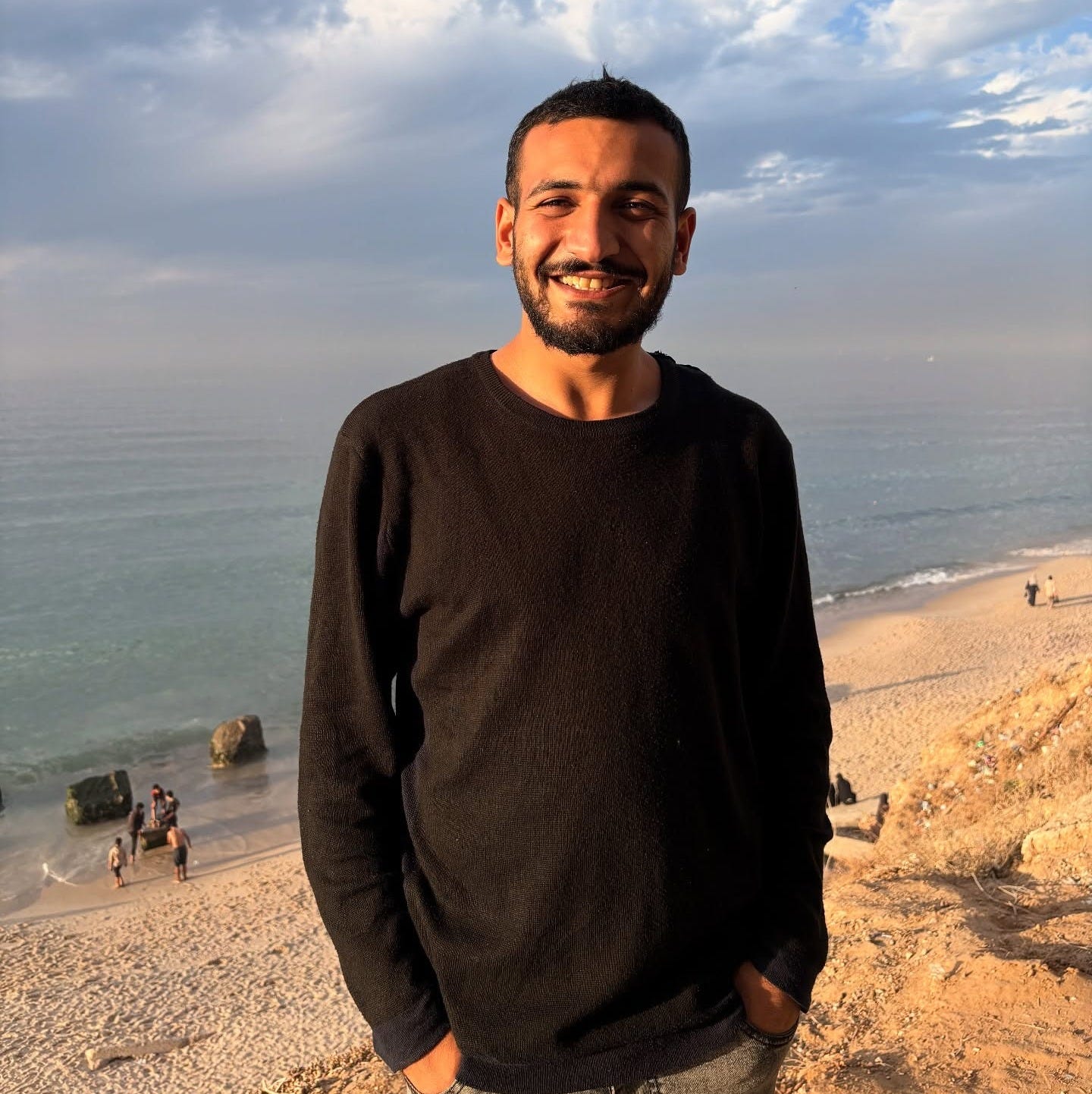
Wasim Said, a physics student-turned-author who wrote the recently-published “Witness to the Hellfire of Genocide: A Testimony from Gaza”, is one of the few writers of books about the genocidal campaign who has remained in the Strip after its publication. We spoke about how he has fared during the winter storm, the writing of his book, and how he sees the narratives of resilience that have colored popular depictions of the Palestinians.
The following interview has been edited for clarity, length, and formatting. The exchange has been translated from Arabic to English.
Séamus Malekafzali: Gaza has been battered by a severe and devastating winter storm over the past several days, can you tell me how you and those around you have been faring? What are the difficulties of weathering this kind of storm inside Gaza that people outside the Strip may not know about, or may not understand the severity of?
Wasim Said: Over the past few days, the storm destroyed my tent and all the tents in the camp where I live. Water flooded everything, and the tents completely collapsed. This is not the first time this has happened. Even before winter truly began, our tent flooded twice, and each time we lost everything we owned.
But what pains me most is not the cold, nor the loss of the few belongings we have, but that crushing feeling of helplessness: to stand there, powerless, unable to do anything, with no options, with children crying and shivering from the cold, and you are unable to protect them or even keep the water from reaching them.
What happened wasn’t a particularly strong storm by the standards we know in Gaza [before the war]. We are used to rain that falls for days without stopping, and to far more severe storms. The problem is that people here are living in tents, and these tents are just an illusion. They offer no protection from the heat of summer, nor from the cold and rain of winter.
What those outside Gaza may not realize is that any rain, even if it’s ordinary, becomes a disaster when you are truly homeless, without any ability to repair or protect yourself, and without any prospects or alternatives.

SM: You [started] writing this book in January, and this current ceasefire came in October. Can you describe how your living conditions have changed since you finished writing this book and the ceasefire, and how they have changed since the ceasefire went into effect?
WS: I began writing this book in January, after my return to Beit Hanoun, during [the] temporary truce. At that stage, writing was an attempt to process what we had lived through and to document it, and therefore the book revisits stories and events that took place before the January truce.
But the writing did not stop when the truce ended. On the contrary, it continued as the genocide resumed in full force. After January, the bombing, killing, and starvation resumed with even greater intensity, to the point that each day was equal, in difficulty, bloodshed, and brutality, to several days [worth] of what had preceded the truce.
During that period, new methods of killing also emerged, among them what we Gazans call “death aid,” a reference to the American organization, [the Gaza Humanitarian Foundation], that claimed to be helping Gazans but whose actions led to the deaths of many people I knew.
Therefore, this book was not something written from a distance. I was writing it while I was actually living through the famine, and during the process of writing, I lost 21 kilograms.
The so-called ceasefire that followed did not fundamentally change the reality of [daily] life: the destruction, insecurity, and the absence of basic necessities have continued.
SM: Have there been any improvements anywhere [in the life of Gazans] that you have seen or has it uniformly gotten worse?
WS: The situation has not improved in any area, [and] in fact, it has worsened. The rapid killing stopped, and the slow killing began. That is all that has happened.
SM: Have there been any efforts at reconstruction within the Gaza Strip that you have witnessed? I saw the video of the reconstruction of al-Shifa Hospital’s maternity ward, where its walls had been repainted, its floors given new finishings, it somehow looked brand new.
WS: In practical terms, everything required for genuine reconstruction in the Gaza Strip is prohibited from entry: essential construction materials, heavy machinery, medical equipment, and even medications are restricted in type and only allowed in limited quantities that do not meet even the minimum level of need.
What was shown in the video related to the maternity ward at Al-Shifa Hospital does not represent reconstruction. This ward is one of the few sections that was not completely destroyed [by the Israeli army], and the damage there was concentrated mainly in the exterior structure due to the destruction of surrounding buildings.
What happened there was limited to painting and some superficial repairs to the floors, which are cosmetic measures that do not reflect a genuine rehabilitation of the hospital or a restoration of its medical capabilities.
SM: I had heard from students how they had been able to continue their studies [during the war] with their professors who would record lectures over WhatsApp, and were able to defend their doctoral dissertations inside of tents. Was this something available to you, or were these isolated examples?
WS: Yes, this is true, universities in Gaza [already had] a complete and fully-integrated online learning system that was developed during the COVID-19 pandemic called Moodle. This system is what helped continue education during the genocide, as it included video lectures for all courses, online exams, and a communication system for professors. All students [in Gaza] were learning this way, and I believe they should all be considered isolated and exceptional cases—in relation to the rest of the world.
SM: You studied physics at the Islamic University in Gaza before the war started. This was the same university that, despite the intentional destruction of much of its campus by the Israeli military, returned to in-person classes in the buildings that remained. Have you been able to return to your education? Have any of your friends been able to return to their studies?
WS: I graduated before the university reinstated in-person classes. As for my friends, before the genocide, there was six of us. Two of them were killed, and another had his leg amputated.

SM: Something I’ve seen you post about is your frustration at the videos I’ve just described, narratives of reconstruction and resilience at a time when the population of Gaza is still suffering immensely. Can you go more into detail about your feelings on these narratives?
WS: What scares me the most is the attempt to romanticize “steadfastness” and to claim we are rebuilding and reconstructing. I truly wish the world could see us rebuilding and restoring our country, but only when that is actually happening.
I believe these videos and images function as a kind of drug for those who promote them, a way to distance themselves from reality and to soothe their consciences. The situation in Gaza is catastrophic, catastrophic in a way that cannot be described by any means.
A people who drown with every rainfall…is this a people rebuilding their country?!
SM: I felt some of the same things you said about steadfastness when Iran was being bombed. I saw certain people in America praising the resilience of the Iranians and how they acted as if the war did not affect them. I wondered if Iranians were seen as not steadfast enough, if the Lebanese were not steadfast enough, if the Palestinians were not steadfast enough, would they still be given solidarity by these people?
WS: I feel that when a person wants to distance themselves from their own duty, they try to exaggerate the steadfastness of others, just to ease their own conscience and avoid taking action to help them. They just stay away and say, “Look how great they are. Look how they endure the suffering.”
SM: Can you tell me about your experiences with the response to your book since it has been released? Was there anything about the responses you’ve received from outside Gaza (or perhaps inside) that has shocked you?
WS: Yes, the reaction of everyone I know here in Gaza was shock. They tell me that I, by doing this, am hastening my death at the hands of these monsters. This is a truth I [already] know, yet I feel terror every time someone reminds me. What crimes these monsters have committed.
Even a cry for help, even a moan of pain, even a last testament before death…if you utter it, they will kill you.
SM: There are photographs at the beginning of the book of where you wrote it, inside your tent, the floor filled with notes. Can you describe the way in which you had to write this? What should people outside Gaza know about the process of attempting to write a book amidst a genocide?
WS: I had kept all those notes in the hope that one day I might share them with the world, but after the last storm I lost everything.
This book, in truth, I was writing as my [last] testament. The scale of death was immense. I was terrified, racing against time for it to reach the world. With every word I wrote, I felt that I was immortalizing a part of myself.
SM: What is it that you want readers outside Gaza to take away from this book, whether they be in the West or the East?
WS: All I hope and wish for is that no one forgets what happened. That what happened be preserved forever, because forgetting it would certainly mean that it will be repeated.
SM: You write about how after the ceasefire in January, that many people in Gaza had what you said was “cautious optimism”. In your case, you were able to return to Beit Hanoun, and however battle-scarred and destroyed much of it was, you still came back and planted a tree, as a means of trying to cement that unwritten future. I know what you have said to me before, but is there any kind of cautious optimism within you, as this ceasefire continues? If not yourself, do you see it in others?
WS: In truth, neither I nor those around me feel anything but terror and fear about the future.
I am from a city called Beit Hanoun, a city that has been completely and utterly destroyed. Nothing left is salvageable. Yet, the Israeli army still controls it and prevents us from returning.
There is no horizon for return to it, and no horizon for life in Gaza.

“Witness to the Hellfire of Genocide: A Testimony from Gaza” is available for purchase from 1804 Books.