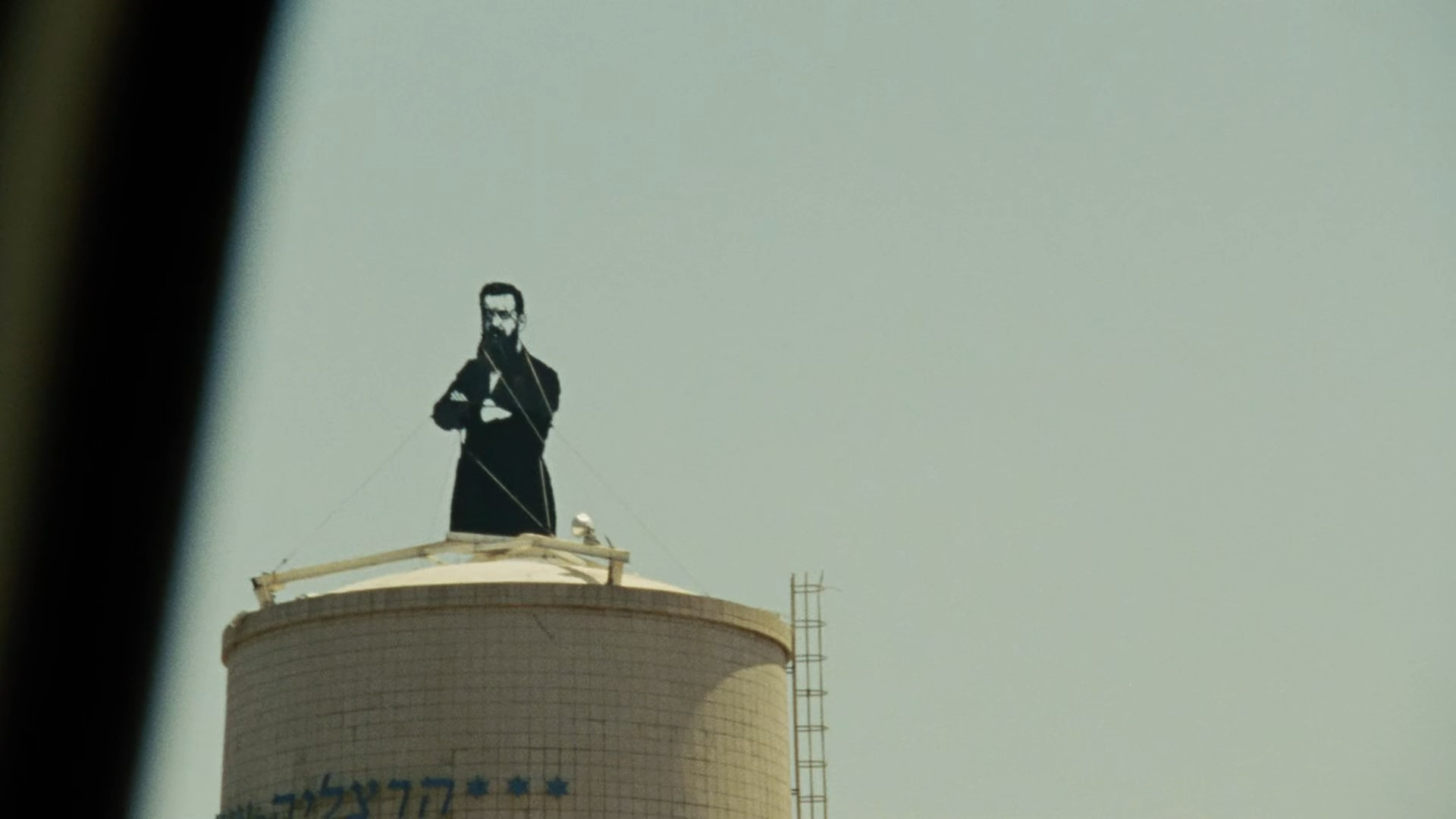
The specter of Theodor Herzl is haunting Israel. Like George Washington in the United States, his name, his work, the reminders of his importance to the country’s birth, are everywhere, burning in the background.
Murals of his image dot towns and kibbutzim all across the land. Streets in Haifa, Lod, and Acre now bear his name. Mount Herzl in Jerusalem holds his tomb, the national Holocaust memorial, and the national cemetery. A city on the coast holding more than 100,000 Israelis is named for him, Herzliya. Even Tel Aviv, Israel’s largest city and the hotbed of the current anti-Netanyahu movement, is named for the Hebrew translated title of Herzl’s book, The Old New Land, in which he envisioned a future utopian Jewish state with strong institutions.
Still, despite all these reminders, like Washington, Herzl is also simultaneously irrelevant. There’s probably not a single Israeli alive today who doesn’t know Herzl’s name, but the ideology he pushed throughout his political career and the arguments he dealt with, however influential at one time, is of no direct and known concern to today’s population. Those who came after Herzl, writers like Ze’ev Jabotinsky, rabbis like Yitzchak Ginsburgh, and ideologues like Meir Kahane, are the ones who remain quoted, whose followings are growing, and whose names are still invoked with vigor today.
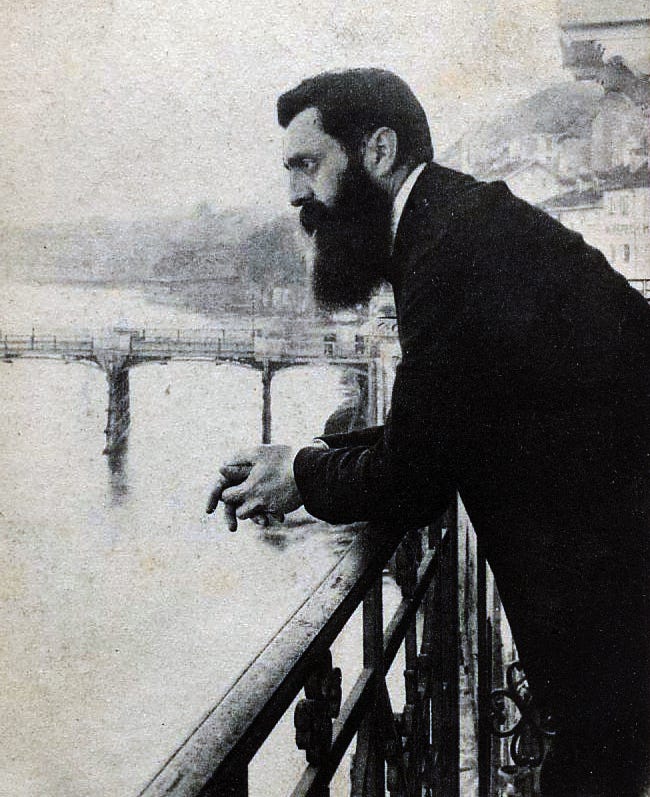
But while Herzl’s utopian vision remains disconnected from the Israel of today, the framework of discourse in which the country operates was birthed primarily in his writings, even if he never lived to see its creation. It was a notion that Israel would be a Jewish state based on democratic fundamentals, whose status would be the envy of the world, and who would proudly serve to be, as Herzl writes in The Jewish State, a “rampart of Europe against Asia, an outpost of civilization as opposed to barbarism.”
The perceived deviation from these principles is where the roots of the current wave of protests against the Israeli government were planted.
Watching coverage of the demonstrations that have rocked Israel for the past 30 weeks straight have produced a common set of vistas. An ocean of blue-and-white flags floating down the highway, like buoys in the tide of the sea. Cameras who stood in the midst of the flurry could not see its end. Trying to capture it all from the air strained the edges of the frame. Hundreds of thousands were out on the street, chanting, marching, waving banners, and they all wanted one thing: an end to the madness that was tearing this country apart.
Israel has never faced a crisis of this scale before, not from within. The country’s population has turned out in droves to face down the prime minister and his cabinet in its quest to overhaul the nation’s judicial system and sterilize its powers. It was undoubtedly an unprecedented attack on Israel’s state institutions, one that was obvious in its intentions for nefarious purposes despite the government’s pathetic insistence of the opposite, and thereby has galvanized many who had never thought to protest before.

Anti-apartheid communists and anarchists, once for the most part on their own in their protests against the Israeli state and its policies, now found themselves wildly outnumbered in the streets, subsumed in crowds that now housed swathes of liberal parliamentarians, proud and unregretful Israel Defense Force families, and even once-allies of Netanyahu in government. Former prime ministers were now speaking about the current cabinet having declared war on its own people and that revolts were now on the horizon, necessary ones. Thousands upon thousands of military reservists of Israel’s army were now announcing they would no longer be fulfilling their mandatory duties, putting the cohesion of the Israeli military itself at risk.
This unusual binding together of forces together in protest, forces not used to protesting much at all before Netanyahu’s time, reminds of the opening lines from the John Patrick Shanley play Doubt: A Parable, as a Catholic priest in New York City describes the feeling in the air that existed after the assassination of President Kennedy the year before.
“Last year when President Kennedy was assassinated, who among us did not experience the most profound disorientation. Despair. ‘What now? Which way? What do I say to my kids? What do I tell myself?’ It was a time of people sitting together, bound together by a common feeling of hopelessness. But think of that! Your bond with your fellow beings was your despair. It was a public experience, shared by everyone in our society. It was awful, but we were in it together!”
The liberal Zionists who have been protesting for more than half a year now have prided themselves on the upholding the mythological perception of Israel that Herzl’s writings initially informed, one of many disparate communities, ideologies, and classes, coming together in pursuit of creating and maintaining a state based on democratic principles that could be a home for the Jewish people.
But myths are myths, and action is action. After 30 weeks of consecutive protest, the movement has achieved nothing.
Mass marches, parliamentary opposition walk-outs, general strikes and unprecedented negative attention from abroad have moved the judicial overhaul plan barely an inch. Last week, Israel’s Knesset voted to disallow the Supreme Court from using “reasonableness” as a common law standard to halt government legislation and the appointment of ministers. This “reasonableness” standard has been one of the few backstops against particularly severe legislation that would have intensified Israel’s occupation of Palestine and restrictions against Palestinian Arab expression within Israel proper. The fact that this standard being overruled would pave the way for a furtherance of Israel’s military operations was touted by Netanyahu’s justice minister at the time of the vote.
Palestine however was something of a sore subject to the demonstrators outside the Knesset’s walls. Most of the protests had focused on how overruling the Supreme Court could allow for the reappointment of ministers like Aryeh Deri, who the court had struck down for his previous convictions for bribery and fraud, and how Netanyahu could avoid conviction in his own trials for bribery and fraud. The liberal Zionists who have propelled this movement into a national phenomenon are concerned with the personal excesses of politicians.
But an interrogation of why those politicians were able to come to power, what fears and prejudices they capitalized on to maintain that power, and what they did with those powers in the West Bank and Gaza before they turned their eyes to Tel Aviv and West Jerusalem, are of far less concern, if not still a societal taboo.
The judicial overhaul plan is about Palestine. It is about removing all restrictions that currently exist on settlement in the West Bank, however few exist. It is about letting police officers and soldiers totally off the hook for brutalizing Arabs, however few times they are actually brought before a court. It is about outlawing Arab parties that dare oppose the cabinet and humiliate them by chanting for Palestinian resistance while in the halls of the Knesset. The seemingly sudden focus on expanding dictatorial laws to Israeli citizens themselves is not out of the blue, it is blowback from decades upon decades of Israeli occupation that has allowed the buildup of settler forces unfettered, who have now turned their eyes back home in pursuit of the creation of their own ideal state.
Even if by some miracle this current Israeli government is stopped in its present mission to overhaul the judicial system, a new conservative and religious government will be on its heels soon enough, with if not a better public relations strategy, then a voting populace that it is more willing to go with its directives than existed before. The failure of the movement to stop Israel’s backsliding is not just in this one instance. It is an inevitability, a complete one.
Israel’s population grows more conservative with every passing year, the incoming generation being more right-wing than the one before it, and the Liberal Zionist age is one that is slowly slipping into irrelevancy. The protesters, despite their sheer numbers, are primarily made up of older Israelis, whose ideology had not been ported over to the younger generation as it had with them by their mothers and fathers.
The anti-Netanyahu movement, while it points in the correct direction, is a doomed one. It is not a dooming that is unique to Israel. Its myriad amalgamation of figures, parties, and groups has created a big tent that can articulate no ideology for a future of the country, only a return to what existed before. Even then, what existed before doesn’t appear to be some vague time in the far past or a specific prime minister, but to many it just seems to be before Netanyahu came to power again last December.
This failure to map out a new vision of the future, one that puts the country on a different path and moreover prevents someone like Netanyahu coming to power again, is critical to Liberal Zionism. It is an insistence that the original tenets of Israel’s creation, or at least what they are believed to be in the here and now, can be retained in perpetuity, that there is a status quo that can be achieved under conditions that existed in the past and can easily be recreated, and that those who insist that the apartheid system that exists in Palestine today needs to be dealt with for anything to change must be dealt with themselves.
This crying out of hundreds of thousands in Israel should not be mistaken as a rebirth of a belief in a country and its future. It is its death rattle. The causes of Israel’s chaotic situation today are inextricably linked with the circumstances of the country’s founding, and moreover, inseparable from the ideological roots of the movement that birthed it, roots that were written out by Herzl more than a hundred years ago.
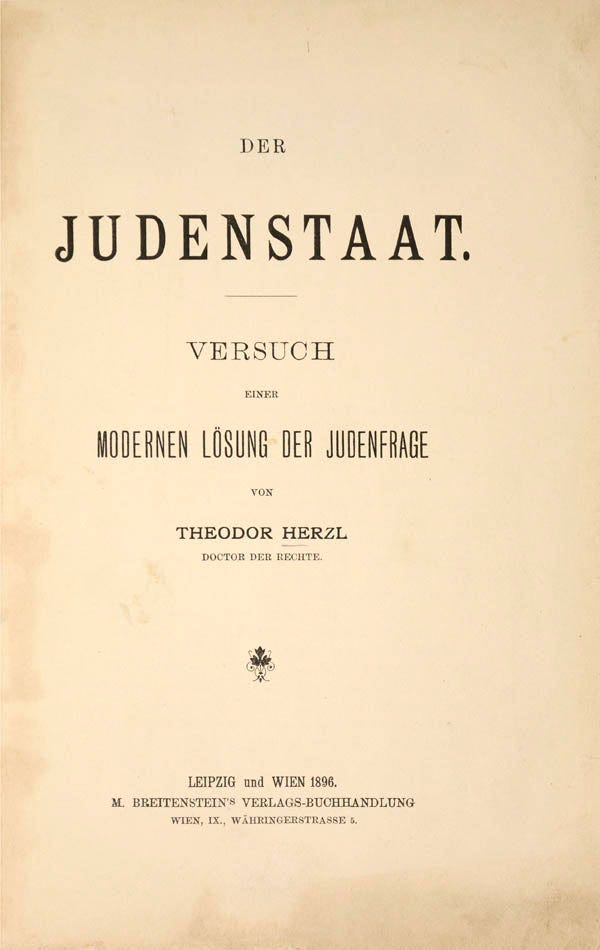
In 1896, Herzl outlined his vision for a future Jewish state in a pamphlet he entitled simply, “The Jewish State”. In just under a hundred pages, Herzl wrote about how the state could be created, by what financial means it could be sustained, and how the Jewish peoples of Europe could move to this new land without hassle or any drop in their standard of living. Herzl was careful of his critics, and wanted to make it clear that despite how it may have seemed on the surface, his vision for a country that the Jewish people could call their own was not an impossible utopia, but in fact a perfectly viable thing.
He was not incorrect in the end about its viability, the State of Israel has been in existence for 75 years now, but Herzl’s envisioning of this future state was not one that included seemingly any mention of how the native Palestinian Arab population, which in 1900 numbered around 564,000 people, would respond to the imposition of a settler state over its cities, towns, and villages. Herzl believed that secretly immigrating to then-Ottoman Palestine would indeed arise a feeling of being threatened in the “native population”, but then went on to say that if mass immigration were to occur under the guise of a sovereign state, then such feelings could be assuaged.
Herzl discusses Palestine as if it were virtually a completely empty tract of land that the Ottoman Empire could be negotiated into handing over to a future Jewish institution that Herzl wanted to construct, a tract where planned cities could be built in droves, settlers could come into port organized but unfettered, and a new society could be constructed that could never be opposed.
Herzl makes comparisons of the society he envisions to white settlers in Africa and America with seemingly not a hint of irony, talking about how the future Jewish state will have regulations on land exploitation similar to the white settler state of Transvaal in present-day South Africa, and that settlers in this new Jewish state will not be in the disorganized mess that the settling of the American West was.
“But today! What is gold-digging like in the Transvaal today? Adventurous vagabonds are not there; sedate geologists and engineers alone are on the spot to regulate its gold industry, and to employ ingenious machinery in separating the ore from surrounding rock. Little is left to chance now. Thus we must investigate and take possession of the new Jewish country by means of every modern expedient.”
Mentions of how the native Africans and the indigenous Americans responded to these colonies is nowhere to be found, instead only used as examples to be followed. Herzl’s pamphlet is filled with a remarkable naivete about the resistance his project would face, with one sentence in its conclusion reading simply, that because the future Jewish state would have the means to defend itself:
“But the Jews, once settled in their own State, would probably have no more enemies.”
Herzl would eventually visit Palestine in 1898 after the writing of this pamphlet. His observations of how the Palestinian Arabs lived led to their eventual inclusion in his later works, but his conclusions would only contribute to a central myth at the heart of Israel’s creation, where Israel supposedly promised the Arabs everything, and they were fools to reject it.
In Herzl’s novel The Old New Land, Herzl imagines a future Jewish state that would be extant in Palestine in the 1920s. Before the creation of the state, Herzl relays his memories of the Ottoman province, describing the city of Jaffa, as in a state of “extreme decay”, that the “inhabitants of the blackish Arab villages looked like brigands”, and describes Jerusalem as a city on the verge of societal collapse:
“Jerusalem by daylight was less alluring—shouting, odors, a flurry of dirty colors, crowds of ragged people in narrow, musty lanes, beggars, sick people, hungry children, screeching women, shouting tradesmen. The once royal city of Jerusalem could have sunk no lower.”
But in the new Jewish state that Herzl details, the Arabs have now become a proud people, on par with the Jews in every aspect of life. There is no hint of any kind of communal conflict or political opposition to the new state. Instead, the Arabs, being blessed with the economic and technological advancements of the Zionist settlers, have abandoned the ways of old, and feel blessed to be a part of this new society. Herzl writes a Palestinian Arab character named Reschid Bey, a resident of Haifa, who tells the main characters of the story bluntly:
“Nothing could have been more wretched than an Arab village at the end of the nineteenth century.”
The attitude of Herzl in The Old New Land is one that is commonly found in colonialist narratives. The population that existed before, if they were ever even considered before, lived in wretched conditions devoid of any culture, politics, or art of their own, and only by being granted opportunities by the occupying power could they advance as a people.
Admittedly, Herzl was still ahead of other European colonial authors, as Arabs in his future state were to enjoy full rights of citizenship, and the antagonist of his story is a racist, anti-Arab rabbi who wants to revoke the citizenship of non-Jews in the nascent state. But the heart of the conflict that would plague Israel was baked into this allegedly supportive vision of a future world, an implicit insinuation.
The Arabs would be supposedly so entranced by the advanced nature of the Jewish state that they would abandon any aspirations to independence, and if they were to reject that, they would be fools, controlled by the same dynamics that had, in Herzl’s mind, left the remains of the Jewish kingdom in ruins before.
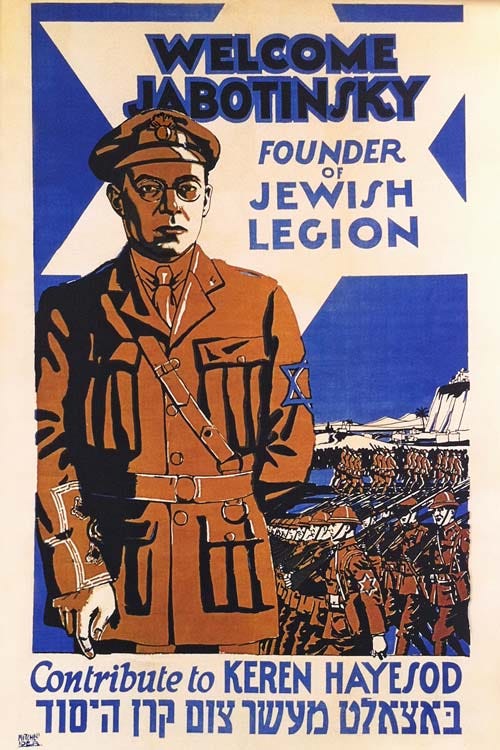
Ze’ev Jabotinsky was an author, like Herzl, but unlike Herzl, was also a soldier. In the early 1900s, as antisemitism reached a fever pitch and pogroms against Jews in Russia, Jabotinsky, Odessa-born at the turn of the 1880s, made it his mission to help Jews defend themselves against those who sought his people’s destruction. Those who met Jews with arms to destroy them would be met with arms right back.
Jabotisnky then fought in World War I in the newly-created Jewish Legion of the British Army with the intention of fighting the Ottoman Empire, and after the war, made his home in the newly-formed British Mandate of Palestine, where he continued his arming efforts with Jewish settlers. In 1920, a couple years after his arrival, he found himself a commander of a group fighting against Palestinian Arabs during the Jerusalem riots, spurred by Arab anger over increasing Jewish settlement from Europe on Palestinian land.
Jabotinsky had come into Zionism during Herzl’s time of influence in the early 1900s, but he would split with the movement in the early 1920s as he became frustrated with what he saw as the abandonment of focus on the key tenet of establishing the Jewish state: securing its territory. To Jabotinsky, this was not solely what we see as Israel proper today, or even an Israel that includes all of the West Bank or Palestine, but an Israel that would have included Jewish settlements on both sides of the Jordan River, bursting into the modern-day Hashemite Kingdom of Jordan, if not a complete conquering.
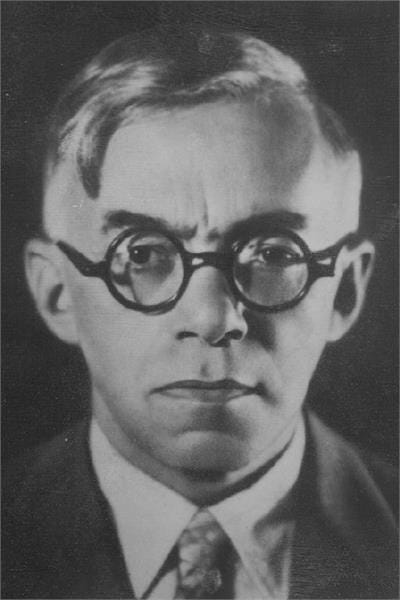
In 1923, the year Jabotinsky split with the mainstream Zionist movement and formed his own revisionist tendency, he wrote out his philosophy in an essay called The Iron Wall. In it, he openly and proudly called the Jewish settlement of Palestine a colonization, and compared the settlers to the original settlers of America, who Jabotinsky called “people of the highest morality, who did not want to do harm to anyone, least of all to the Red Indians,” and decried that the “native population fought with the same ferocity against the good colonists as against the bad.”
Jabotinsky understood that indigenous people would fight against a “new master” because like anyone, it “regards its lands as its national home, of which it is the sole master, and it wants to retain that mastery always.” Jabotinsky knew that the Arabs, even though he thought of them as far less advanced than the Jewish settlers, could see right through Zionist obfuscation about their true aims, and that they would never voluntarily agree to come under the fold of the Jewish state without a fight.
“This is equally true of the Arabs. Our Peace-mongers are trying to persuade us that the Arabs are either fools, whom we can deceive by masking our real aims, or that they are corrupt and can be bribed to abandon to us their claim to priority in Palestine, in return for cultural and economic advantages. I repudiate this conception of the Palestinian Arabs.
Culturally they are five hundred years behind us, they have neither our endurance nor our determination; but they are just as good psychologists as we are, and their minds have been sharpened like ours by centuries of fine-spun logomachy. We may tell them whatever we like about the innocence of our aims, watering them down and sweetening them with honeyed words to make them palatable, but they know what we want, as well as we know what they do not want. They feel at least the same instinctive jealous love of Palestine, as the old Aztecs felt for ancient Mexico, and their Sioux for their rolling Prairies.
To imagine, as our Arabophiles do, that they will voluntarily consent to the realization of Zionism in return for the moral and material conveniences which the Jewish colonist brings with him, is a childish notion, which has at bottom a kind of contempt for the Arab people; it means that they despise the Arab race, which they regard as a corrupt mob that can be bought and sold, and are willing to give up their fatherland for a good railway system.”
But he did not seek Arab expulsion from Palestine, still holding onto that old Herzlian belief, however threadbare. But he believed that living side-by-side with the Arabs could only be achieved through submission, where Jewish settlement becomes impossible to uproot, and all hope to reverse the wave is lost.
“And when that happens, I am convinced that we Jews will be found ready to give them satisfactory guarantees, so that both peoples can live together in peace, like good neighbors.”
Jabotinsky, unlike Herzl, had been forced to reckon with the Palestinian population that he sought the domination of, and he knew that in order to realize the Jewish state that had been envisioned at the Zionist Congresses all those years before, that military might, domination, and imperial statecraft had to be at the heart of its creation, just like every other attempt at colonization before it.
Jabotinsky died in 1940. Like Herzl, he would never see the realization of the State of Israel. But Jabotisnky’s ideology would find its way into the modern Israeli nation-state through politicians who trained in groups he had founded, prime ministers like Yitzhak Shamir and Menachem Begin. Jabotinsky’s personal secretary had a son would also find inspiration in Jabotinsky’s work. His secretary was named Benzion Netanyahu.

Rabbi Meir Kahane was born in Brooklyn in 1932. Unlike Herzl, who had lived most of his life without any inclination toward the idea of a Jewish state, and unlike Jabotinsky, who actively participated in the creation of the state though he did not live to see it, Kahane was a teenager when Israel was formed. Kahane had grown up in a Revisionist Zionist household, and Jabotinsky, while on tours through the United States to drum up support for Zionist causes, had before been a guest in Kahane’s family home. Jabotinsky made a significant imprint on a young Meir, then named Martin, and his philosophy would inform how Kahane envisioned the path Israel should take now that it had achieved independence on the land of the Palestinian Arabs.
Some 700,000 Palestinians had been forced to flee their homes. Hundreds of villages had been destroyed. The collective Arab armies that sought to finally expel the Zionist settlers once and for all had failed in spectacular fashion, underestimating the strength and cohesion of their opponents. The Nakba, the catastrophe, was instrumental to the creation of the State of Israel, as without the expulsion of the majority Arab population, a Jewish majority-state in Palestine could not exist. The naïve Herzlian ideal that the Palestinians would give up all their dreams of independence and all their aspirations to individual politics was dead. In its place would erupt an exclusionary narrative that, while still informed by that initial mythology, was now tinged with the militarism of Jabotinsky’s writings, as well as the newfound reality of Israel’s creation and what circumstances brought it about.
Israel had supposedly promised the Arabs everything, and they had refused out of a seemingly incomprehensible arrogance. And now they were owed nothing.
The 1947 UN Partition Plan would become of particular note in Zionist apologia in the decades to come. The plan would have split Mandatory Palestine into two, one Jewish state, one Arab. The sections the Arabs would be given were large but barely contiguous, and similar problems plagued the Jewish sections. The Zionists agreed to the plan, seeing as it gave them wide swathes of territory. The Arabs, seeing as they were the original inhabitants and didn’t understand why they had to give up their land to anybody, refused. The Zionist movement seized on this refusal, and would use it as primary evidence of how the Arabs were ungrateful for what they had initially been given.
In an article entitled Palestine?, Kahane outlined this argument with barely-veiled disdain:
“If there are those who wish to create something known as ‘Palestine’ they are welcome to do so in ‘Jordan’ which in itself is a fictitious state created by the imperialist British by cutting away, in 1921, the eastern part of the Land of Israel. The Arabs who call themselves ‘Palestinians’ had the opportunity to create a ‘Palestine’ in a far larger part of the Land of Israel, but refused to do so. They lost that chance forever and if they refuse to create a state in ‘Jordan’ now, but insist upon war, they will lose again and lose ‘Jordan’ in the process […]”
As the decades rolled on, and it became evident that Palestinian Arab resistance would not acquiesce even if the State of Israel had been formed and recognized by many, Meir Kahane saw an opening for his own philosophy to begin to take hold. Kahanism was informed by a want for a Jewish theocracy in Israel, where Israelis would be judged not by secular law, but by the Halakha, by Jewish religious law. Israel, despite its foundations as a state for Jews and as a Jewish state, was not an explicitly religious one, and Herzl himself had been adamant that while Rabbis should be given prominence in society, they should be held back from power.
But Kahanism was also informed by something that far more Israelis were willing to listen to him on: terrorism, and more specifically, how he believed terrorism exists because Israel continues to pursue a failed policy of reconciliation with its Arab population, and that the only way to solve it would be to expel them entirely.
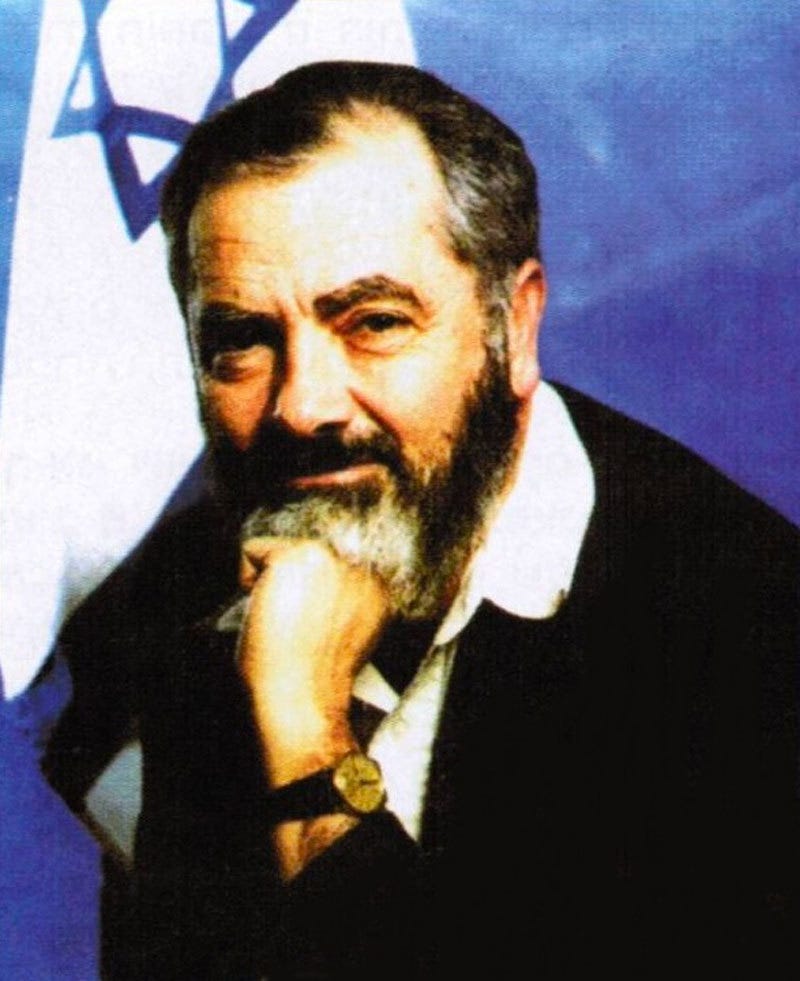
Jabotinsky had believed that while the Palestinians would never accept Zionist control voluntarily, they would one day capitulate, see the achievements of the Jewish state, and would send less stubborn leaders to negotiate, paving the way for racial equality in the near future. Kahane, having seen that the Palestinians, even after Israel’s creation and economic prosperity, still held onto the idea of returning their former homes, retaining their culture, and living in independence, was livid. He openly scorned the idea of equality, and adapted Jabotinsky’s argument of respecting the Arabs as opponents into a lesser, cruder version, one where the Arabs in his mind were rejecting civilization entirely, and therefore could never be convinced of Israel’s greatness.
In an election campaign ad in 1988, Kahane says this:
“They [leftists and liberals] think that if we would give them high living standards, an indoor toilet, they’ll be good Arabs. What contempt. You can’t buy a person’s national pride with an indoor toilet, with higher living standards. The Arab is a proud person, and the only Jew that understands the Arab is a Jew who is a proud person. I understand the Arabs, they understand me, that is why they must go.”
Kahane was reviled by the mainstream Israeli establishment at the time who insisted that this racism had no place in the state, despite his party, Kach, gaining in the polls during the 1980s. But Kahane was no aberration, and his ideological successors who are currently in government in Jerusalem now are not ones either. It is easy to dismiss Kahane and Itamar Ben-Gvir and Bezalel Smotrich as corrupted sons, those who have diverted from the ideals of Israel in ways that are inexplicable and strange, but the trends and paths of history dictate otherwise. They are the inevitable successors, products of a movement informed by European colonialism of old, and moreover travelers on a path that even Herzl himself predicted, though in ways he did not anticipate.
The antagonist of The Old New Land is Rabbi Geyer, which is German for “vulture”. Geyer, in this alternate Jewish state of the 1920s, desires to disenfranchise the Arabs who have thus far been granted equal rights in this new system. His electoral defeat and eventual departure is supposed to be a showcase of the strong institutions that the then-future Jewish state would have, and how they would be capable of defeating any threat to its democratic ideals. But one wonders how this actually could be avoided in the kind of state Herzl is envisioning, to always rely on the perpetual hope that racism could always be defeated in a state that inherently prioritized one race over the other. If the Palestinian Arabs had been allowed to simply live in peace, the threat of Herzl’s Rabbi Geyer would never have existed.
We see now that this Herzlian ideal, like many of his, was based on naivete. So much of the proposals for the Jewish state relied on a perfect soaring past all possible obstacles, hoping that first the native population would never factor in at all, and then revising it to hope that the native population would welcome such a settler-colonial project with open arms in eternal gratefulness. But Zionism was built out of the discoursal framework of European colonialism and the utopian myths it produced, and just like the rebellions of the colonized that had come before and would come to pass in those European holdings, so too were they inevitable in Palestine.
Herzl never considered these possibilities, and thereby Zionism was built out of this lack of consideration, and when Zionists were forced by reality to consider them, they reacted in anger at having to be forced to consider them at all.
Liberal Zionism cannot save Israel. The mythology of a democratic state that they are fighting for never existed truly, as it only really existed for the select few that were granted such privileges.
Despite their protests, they are still trapped, willingly, in the framework that the right-wing they despise also operate in: Israel cannot fail. It can only be failed by others.